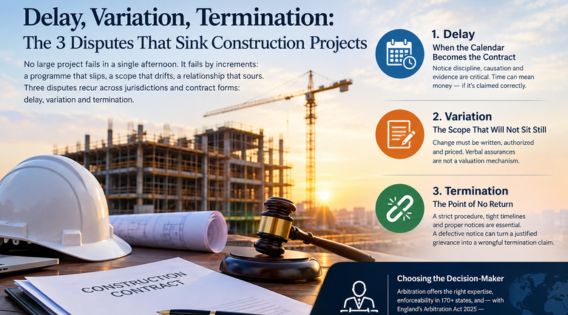
No large project fails in a single afternoon. It fails by increments: a programme that slips, a scope that drifts, a relationship that sours. Three disputes recur across jurisdictions and contract forms: delay, variation and termination.
- Delay: When the Calendar Becomes the Contract
Delay is rarely one party’s doing, yet the questions are simple: is the contractor entitled to more time, and does that time carry money? Causation decides, and evidence decides causation. Notice discipline is strict. Under FIDIC 2017, notice is due within 28 days of awareness and a fully detailed claim within 84 days; the AIA A201-2017 allows 21 days. The SCL Delay and Disruption Protocol (2nd edition, 2017) stresses that contemporaneous records outweigh later reconstruction, and that genuine concurrency may earn time without necessarily earning money.
- Variation: The Scope That Will Not Sit Still
Change is the ordinary friction of building; the dispute lies in its paperwork. Was the instruction written, authorized and priced? FIDIC and AIA forms channel change through formal instructions and change orders to avoid exactly these arguments. A contractor who proceeds on a verbal assurance learns that goodwill is not a valuation mechanism.
- Termination: The Point of No Return
Termination is a remedy of last resort with a strict procedure, and a party that invokes it prematurely may become the party in breach. Under FIDIC 2017, a notice to correct (Sub-Clause 15.1) is followed by a notice of intention to terminate (Sub-Clause 15.2), giving the contractor 14 days to remedy before a second notice ends the contract. A defective notice or a missed cure period can turn a justified grievance into a wrongful termination claim.
Choosing the Decision-Maker
Such disputes are technical and time-sensitive, which is why arbitration suits them: the parties choose a decision-maker fluent in critical-path analysis, and the award is enforceable in more than 170 states under the New York Convention. England’s Arbitration Act 2025, in force since 1 August 2025, adds an express power of summary disposal.
Appointment matters as much as procedure. A construction dispute arbitrator brings discipline to notice, causation and quantum. An energy dispute arbitrator understands layered EPC contracts, and a joint venture dispute arbitrator can untangle a consortium when the partners themselves fall out. Where an English-law contract is performed in America, an English arbitrator in USA, at home in both traditions, reduces the friction of translation between systems.
From the vantage point of a member of an arbitral tribunal, construction cases are seldom won on principle and almost always on paperwork. Serve the notice, document the change and follow the termination clause to the letter.